
Linkedin Google Scholar ResearchGate GitHub Twitter

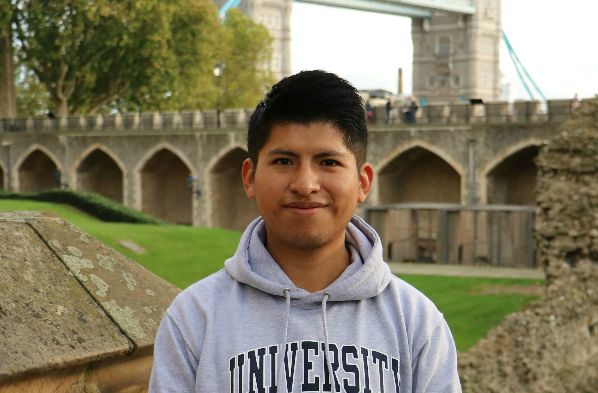
Edwin Salcedo


I'm a PhD Researcher at Queen Mary University of London. My current research explores how Multimodal AI can support better decision-making in healthcare. Previously, I worked as a Lecturer and Research Engineer in Computer Vision at Universidad Católica Boliviana "San Pablo" from 2020 to 2025. There, I combined software and hardware to build intelligent systems. I also hold an MSc in Advanced Software Engineering from the University of Sheffield and a PgDip in Machine Learning and Big Data from the Pontifical Catholic University of Chile. Read more about my background here.

News

Edwin Salcedo PUBLICATIONS PROJECTS

About

  • Years of Experience in Tech

    13
  • Publications

    8
  • Citations

    50
  • Some Stats
Bio Research Interests Skills

Bio

Edwin Salcedo is a PhD Researcher at Queen Mary University of London, in the School of Electronic Engineering and Computer Science, where he studies multimodal artificial intelligence for healthcare. His research focuses on designing and building computer vision systems that can run efficiently on resource-constrained platforms. In particular, he is interested in investigating deep learning and multi-modal learning workloads, enabling efficient inference when consuming data in the form of images, audio, and graphs. He has received over 14 awards and grants for his research projects, of which the most important are shown below.


Previously, he worked as a Lecturer and Research Engineer at Universidad Catolica Boliviana "San Pablo" from 2020 to 2025. He completed an M.Sc. in Advanced Software Engineering at The University of Sheffield (United Kingdom) in 2018, where he later worked as a Research Software Engineer and Graduate Teaching Assistant. He also completed an MBA in Digital Businesses at the Valencia Poliytechnic Valencia (Spain) and a PgDip in Machine Learning and Big Data at Pontifical Catholic University of Chile (Chile).


Outside of the academic arena, he has extensive experience as a software engineer, IT manager, and team lead. He also worked as a Data Scientist, Research Consultant, and Machine Learning Specialist for Hivos, Swisscontact, and Tigo, respectively, until August 2021.


Skills

MLOps
95%
Computer Vision
95%
Data Science
85%
Natural Language Processing
55%
Internet of Things
75%

Research Interests

Multimodal AI

I'm fascinated by multimodal AI because it brings together signals such as images, text, audio, and structured data, enabling more complete and context-aware intelligent systems for real-world applications like healthcare.

Computer Vision

I'm fascinated by computer vision because it enables machines to "see" and interpret the world, opening up endless possibilities for innovation in fields like healthcare and smart cities.

Deep Learning

I find deep learning captivating due to its ability to uncover intricate patterns in vast amounts of data, leading to breakthroughs in image recognition.

Edge Computing

I'm intrigued by edge computing because it brings computation closer to the data source, enabling real-time processing, reduced latency, and increased efficiency.

Generative Artificial Intelligence

I'm amazed by generative artificial intelligence because it empowers machines to create new content and ideas, pushing the boundaries of AI assistance in areas like healthcare.

Domain Adaptation

I'm interested in domain adaptation because it helps models transfer what they learn across different datasets and environments, making AI systems more robust and reliable in real-world settings.

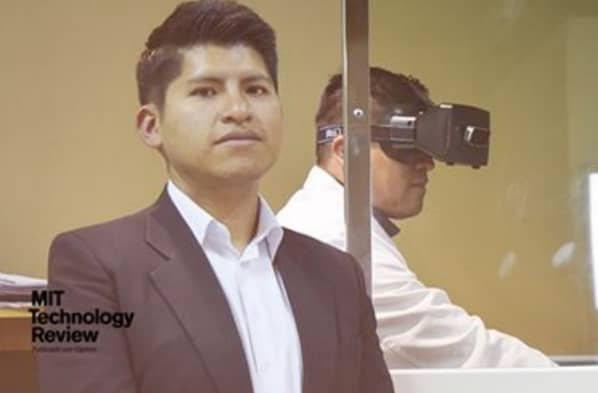
MIT Innovator Under 35 (2017)

Awarded for my work in medical imaging and virtual reality.

Chevening Scholarship (2017/2018)

Sponsored by the British government to pursue further studies in Advanced Software Engineering.

National Science Prize (2016, 2023, & 2025)

Awarded three times for my work in computer vision.

TensorFlow Faculty Award (2021)

Awarded to teach and research computer vision for early wildfire detection.

OpenCV AI Competition Winner (2022)

First Prize winner team among 120 teams worldwide.

Canadian Fund for Local Initiatives (2024)

Awarded to research about heavy metal detection using unmanned surface vehicles.

"Universidad Católica Boliviana San Pablo"

2020 - 2025

Lecturer · Research Engineer
Computer Vision/Machine Learning/Software Engineering/Teaching

- Prototyped IoT software systems and chatbot assistants.
- Supervised 12 undergraduate and 3 postgraduate dissertations.
- Taught modules including SIS-341 Intelligent Systems, IMT-344 Computer Vision, BDS-253 Data Mining, and DAA-530 Unsupervised Machine Learning.
- Received the Teaching Excellence Award in 2023.
- Secured five international grants totalling $60,000 to support research projects.
- Independently initiated and published 12 peer-reviewed research papers in deep learning and computer vision beyond formal institutional responsibilities.

Education

Publications

2025

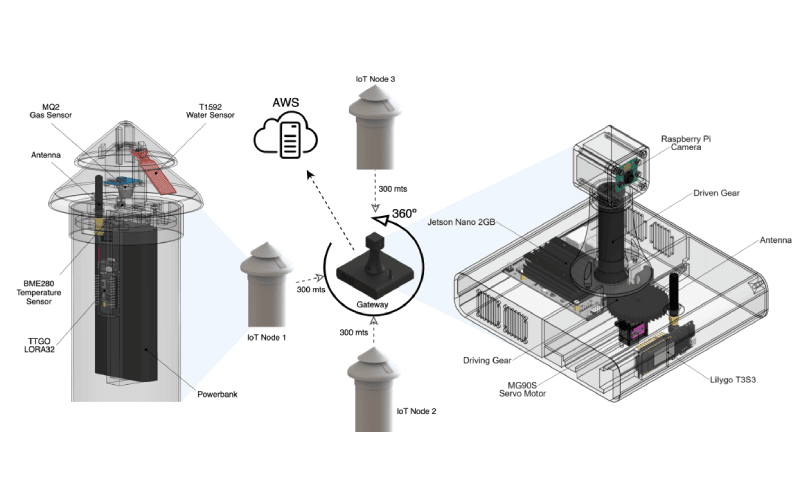
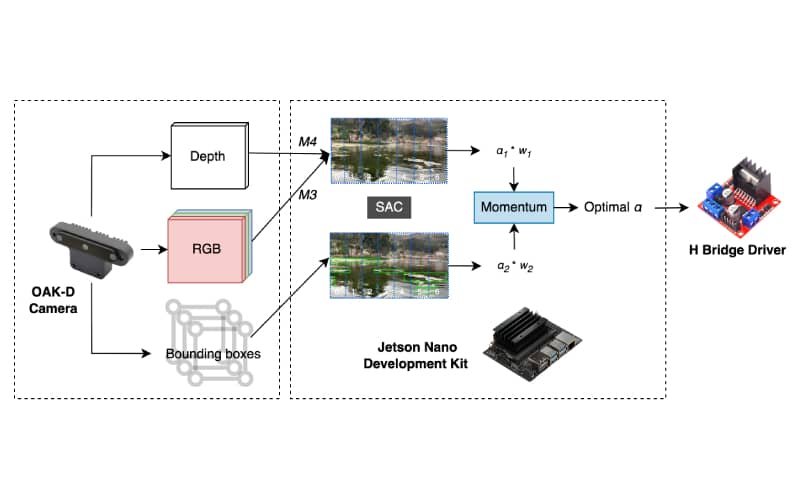
ForestProtector: An IoT Architecture Integrating Machine Vision and Deep Reinforcement Learning for Efficient Wildfire Monitoring Conference Paper

Abstract: Early detection of forest fires is crucial to minimizing the environmental and socioeconomic damage they cause. Indeed, a fire's duration directly correlates with the difficulty and cost of extinguishing it. For instance, a fire burning for 1 minute might require 1 liter of water to extinguish, while a 2-minute fire could demand 100 liters, and a 10-minute fire might necessitate 1,000 liters. On the other hand, existing fire detection s Continue reading...

Author(s): Kenneth Bonilla Ormachea, Horacio Cuizaga, Edwin Salcedo, Sebastian Castro, Sergio Fernandez, Misael Mamani

ICARA 2025, Zagreb, Croatia

Oral presentation


2024

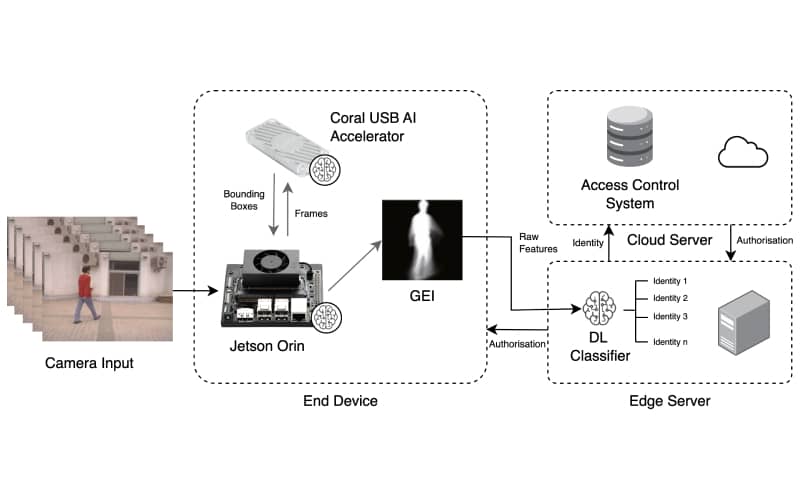
Computer Vision-Based Gait Recognition on the Edge: A Survey on Feature Representations, Models, and Architectures Journal Article

Abstract: Computer vision-based gait recognition (CVGR) is a technology that has gained considerable attention in recent years due to its non-invasive, unobtrusive, and difficult-to-conceal nature. Beyond its applications in biometrics, CVGR holds significant potential for healthcare and human–computer interaction. Current CVGR systems often transmit collected data to a cloud server for machine learning-based gait pattern recognition. While effec Continue reading...

Author(s): Edwin Salcedo

Journal of Imaging

Towards Continuous Floating Invasive Plant Removal Using Unmanned Surface Vehicles and Computer Vision Journal Article

Abstract: Deficient domestic wastewater management, industrial waste, and floating debris are some leading factors that contribute to inland water pollution. The surplus of minerals and nutrients in overly contaminated zones can lead to the invasion of different invasive weeds. Lemnoideae, commonly known as duckweed, is a family of floating plants that has no leaves or stems and forms dense colonies with a fast growth rate. If not controlled, duc Continue reading...

Author(s): Edwin Salcedo, Yamil Uchani, Misael Mamani, Mariel Fernandez

IEEE Access


2023

Edge AI-Based Vein Detector for Efficient Venipuncture in the Antecubital Fossa Conference Paper

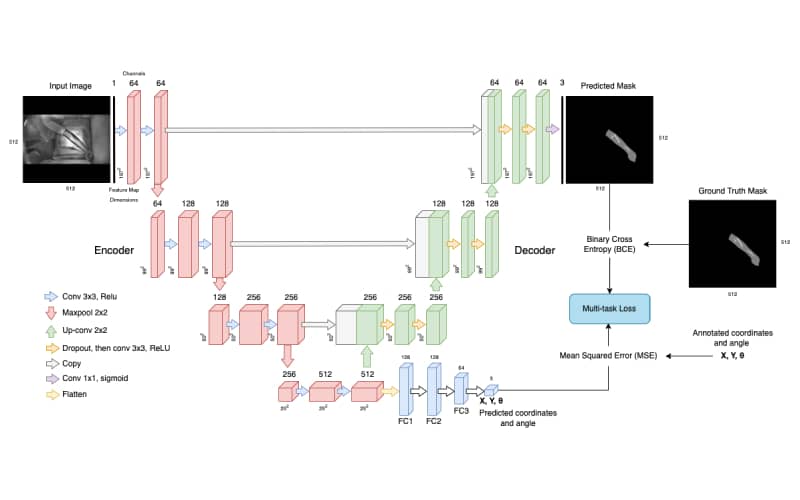
Abstract: Assessing the condition and visibility of veins is a crucial step before obtaining intravenous access in the antecubital fossa, which is a common procedure to draw blood or administer intravenous therapies (IV therapies). Even though medical practitioners are highly skilled at intravenous cannulation, they usually struggle to perform the procedure in patients with low visible veins due to fluid retention, age, overweight, dark skin tone Continue reading...

Author(s): Edwin Salcedo, Patricia Peñaloza

MICAI 2023, Mérida, México

Code Preprint Oral presentation


2022

A Novel Road Maintenance Prioritisation System Based on Computer Vision and Crowdsourced Reporting Journal Article

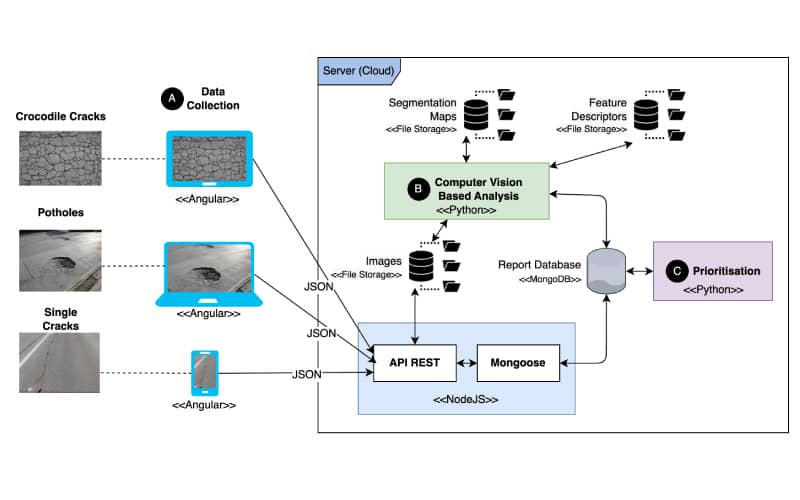
Abstract: Maintenance of critical infrastructure is a costly necessity where developing countries often struggle to deliver timely repairs. The transport system acts as the arteries of any economy in development, and the formation of potholes on roads can lead to injuries and loss of lives. Recently, several countries have enabled pothole reporting platforms for their citizens, so that repair work data can be centralised and visible for everyone. Continue reading...

Author(s): Edwin Salcedo, Mona Jaber, Jesús Requena Carrión

Journal of Sensor and Actuator Networks


Projects

  • All
  • Robotics
  • Computer Vision

CONTRIBUTIONS ON GITHUB

Teaching/Mentoring

Taught Courses


IMT-344 Computer Vision introduced Mechatronics Engineering students to artificial vision methods for inspection, monitoring, and control applications. The course covered digital image processing, segmentation, visual feature extraction, image compression, video analysis, optical flow, and real-time computer vision workflows. It also introduced machine learning and deep learning approaches for visual recognition, including classical classifiers, convolutional neural networks, transfer learning, object detection, semantic and instance segmentation, attention mechanisms, transformers, and generative models. Students completed a collaborative final project using Python-based computer vision and machine learning tools.

Level: Undergraduate

Duration: 1 semester

Offerings: Spring 2021, Fall 2021, Spring 2022, Fall 2022, Spring 2023, Fall 2023, Spring 2024, Fall 2024, Spring 2025
Tools: PyTorch TensorFlow OpenCV Numpy Python

This course introduced students to the practical foundations of deploying, managing, and monitoring machine learning systems in production. The module covered the full ML lifecycle, from developing models with Scikit-learn and TensorFlow to tracking experiments, versioning code and data, packaging models with Docker, testing ML pipelines, and monitoring model performance after deployment. Through practical sessions and case studies, students learned how to build more reproducible, scalable, and maintainable ML workflows using modern MLOps tools and practices.

Level: Postgraduate

Duration: 1 month

Offerings: E1 2023, E2 2023, E3 2024, E4 2025, E5 2025

Tools: Scikit-learn TensorFlow MLflow Docker DVC

This course introduced students to the main concepts, algorithms, and applications of unsupervised machine learning. The module covered clustering methods such as K-means, hierarchical clustering, DBSCAN, HDBSCAN, and Gaussian Mixture Models, as well as dimensionality reduction techniques including PCA, Factor Analysis, Independent Component Analysis, t-SNE, and UMAP. Students also explored more advanced topics such as autoencoders, graphical models, semi-supervised learning, clustering for word embeddings, and clustering for visual data. Through practical laboratories, paper discussions, and applied case studies, the course helped students understand how to discover hidden patterns, reduce complex feature spaces, and apply unsupervised learning techniques to real-world data problems.

Level: Postgraduate

Duration: 1 month

Offerings: E1 2022, E2 2022

Tools: Scikit-learn TensorFlow Keras UMAP-learn HDBSCAN Matplotlib

This course introduced students to the main concepts, algorithms, and applications of unsupervised machine learning. The module covered clustering methods such as K-means, hierarchical clustering, DBSCAN, HDBSCAN, and Gaussian Mixture Models, as well as dimensionality reduction techniques including PCA, Factor Analysis, Independent Component Analysis, t-SNE, and UMAP. Students also explored more advanced topics such as autoencoders, graphical models, semi-supervised learning, clustering for word embeddings, and clustering for visual data. Through practical laboratories, paper discussions, and applied case studies, the course helped students understand how to discover hidden patterns, reduce complex feature spaces, and apply unsupervised learning techniques to real-world data problems.

Level: Postgraduate

Duration: 1 month

Offerings: Jan 2020, June 2023

Tools: Scikit-learn TensorFlow Keras UMAP-learn HDBSCAN Matplotlib

This course introduced students to the foundations of data mining, from data collection and preprocessing to feature engineering, exploratory data analysis, visualisation, predictive modelling, clustering, and anomaly detection. The module covered the knowledge discovery process, structured and unstructured data processing, dimensionality reduction, regression, classification, segmentation, distance-based methods, and model evaluation. Through practical laboratories, guided exercises, and a final applied project, students developed Python-based data mining solutions for discovering patterns, extracting insights, and supporting decision-making in business or institutional contexts.

Level: Undergraduate

Duration: 1 semester

Offerings: Spring 2023, Spring 2024, Spring 2025

Tools: Python Pandas Scikit-learn Matplotlib Jupyter Notebook

This course introduced students to essential software engineering practices for building reliable and maintainable data science projects. The module covered Python programming, data structures, object-oriented programming, Python environments and IDEs, file and directory management, modules and packages, coding best practices with PEP8, version control systems, and containerised deployment with Docker. Through practical sessions and a final project, students learned how to organise code, manage dependencies, apply software development principles, and prepare data science applications for reproducible development and deployment.

Level: Postgraduate

Duration: 1 semester

Offerings: E2 2022, E3 2023, E4 2025

Tools: Python Jupyter Notebook Git Docker

This course introduced students to the foundations of intelligent systems and artificial intelligence, covering both symbolic and data-driven approaches. The module explored core AI concepts, rational agents, state-space modelling, uninformed and informed search algorithms, machine learning, and neural networks. Students applied NumPy, Scikit-learn, and TensorFlow to solve problems involving regression, classification, clustering, association, artificial neural networks, and deep learning. Through theoretical units, practical implementation tasks, and a final course project, students developed intelligent systems capable of reasoning, learning from data, and solving real-world computational problems.

Level: Undergraduate

Duration: 1 semester

Offerings: Spring 2023, Fall 2024

Tools: Python NumPy Scikit-learn TensorFlow Jupyter Notebook

This technical course introduced participants to the foundations of machine learning, natural language processing, and chatbot development. The course covered supervised and unsupervised learning, text processing with Python and NLTK, introductory NLP and deep learning concepts, and the development of conversational assistants using the Rasa framework. Participants also explored deployment and monitoring considerations for NLP models, with practical sessions leading to the presentation of chatbot projects.

Format: Workshop

Duration: 2 weeks

Offerings: September 2021

Tools: Python NLTK Rasa TensorFlow Jupyter Notebook

This course introduced participants to the foundations and practical applications of computer vision, with a focus on developing solutions aligned with the Sustainable Development Goals. The programme covered image formation, image processing, point operations, filtering, edge detection, image transforms, morphological operations, segmentation, motion analysis, data processing, machine learning, neural networks, convolutional neural networks, transfer learning, object detection, semantic segmentation, instance segmentation, and model deployment. Through lectures, laboratory notebooks, office hours, and final projects, participants learned how to build computer vision applications using Python-based tools and apply them to real-world social and environmental challenges. The course was delivered as a three-month remote bootcamp, with 60 accepted participants and 40 finalists from six cities in Bolivia.

Format: Bootcamp

Duration: 3 months

Offerings: June 2022

Tools: Python OpenCV NumPy TensorFlow TensorFlow Lite

This course introduced students to the foundations and practical applications of computer vision for industrial environments. The module covered the main stages of a computer vision system, including image acquisition, preprocessing, segmentation, representation, feature extraction, recognition, interpretation, and compression. Students explored topics such as colour spaces, camera and lighting selection, image processing, spectral filters, morphological techniques, automated visual inspection, object recognition, and introductory machine learning methods for image analysis. Through lectures, practical laboratories, paper discussions, and a final mini-project, students learned how to design and implement computer vision pipelines for tasks such as defect detection, surveillance, robotics, and automated industrial inspection.

Level: Postgraduate

Duration: 1 semester

Offerings: 2021

Tools: Python OpenCV NumPy Scikit-learn PyTorch

This course introduced students to the core principles of artificial intelligence and their practical application in technology-driven decision-making. The module covered intelligent agents, search agents, AI development environments, Python data structures, object-oriented programming, automated data processing, machine learning, deep learning, and algorithmic bias and fairness. Through lectures, group laboratories, an individual exam, and a final project, students learned how to design and implement basic AI solutions using Python-based tools while considering both technical and methodological aspects of intelligent systems.

Level: Postgraduate

Duration: 1 month

Offerings: 2024

Tools: Python Pandas NumPy Scikit-learn TensorFlow

This course introduced students to the foundations of data science, data mining, and descriptive modelling for discovering patterns in structured and unstructured datasets. The module covered Python programming, object-oriented programming, relational databases with SQL, Python–SQL integration, feature engineering, dimensionality reduction, PCA, clustering methods such as K-means, DBSCAN, HDBSCAN, hierarchical clustering, Gaussian Mixture Models, association rules, anomaly detection, and large-scale unstructured data processing. Through laboratories, in-class exercises, case study presentations, and a final project, students learned how to process, analyse, and model data to support predictive and descriptive decision-making tasks.

Level: Postgraduate

Duration: 1 month

Offerings: 2024

Tools: Python Pandas NumPy SQL Scikit-learn

This course introduced students to practical data modelling techniques for structured and unstructured data. The module covered Python data structures, feature engineering, dimensionality reduction, PCA, supervised learning for regression and classification, evaluation metrics, hyperparameter optimisation, cross-validation, boosting models, unsupervised learning, clustering metrics, anomaly detection, association rules, introductory NLP, deep learning, TensorFlow/Keras, convolutional neural networks, and transfer learning. Through laboratories, in-class exercises, exams, and a final course project, students developed applied machine learning workflows for analysing, modelling, and extracting insights from diverse data sources.

Level: Postgraduate

Duration: 1 semester

Offerings: 2025

Tools: Python Scikit-learn Pandas TensorFlow/Keras Jupyter Notebook

This course introduced students to the core concepts, technologies, and architectures behind Internet of Things systems. The module covered the evolution of computing, IoT devices and sensors, cyber-physical data collection, sensing and actuation, communication mechanisms, IoT architectures, service-oriented solutions, and practical implementation examples. Students also explored the use of Arduino with C and Raspberry Pi with Python, as well as key considerations for designing connected systems in real-world environments. Through theoretical sessions, guided laboratories, readings, and a final project, students developed a practical understanding of how IoT solutions connect physical objects, data, and digital services across domains such as smart cities, healthcare, logistics, transportation, and security.

Level: Postgraduate

Duration: 1 semester

Offerings: 2020

Tools: Arduino Raspberry Pi Python C MQTT

This course introduced students to the foundations of computer programming and algorithmic problem-solving. The module covered computer systems, problem analysis, pseudocode, flowcharts, algorithm design, sequential structures, conditional statements, loops, nested loops, standard operators and functions, and string manipulation. Students progressed from representing solutions as algorithms to implementing programs in a high-level programming language, developing the logical and practical skills needed to solve computational problems through structured programming.

Level: Undergraduate

Duration: 1 semester

Offerings: Spring 2020

Tools: Python C/C++ Pseudocode Flowcharts IDEs

Teaching Assistant Work


This course introduced students to the foundations and practical development of Internet of Things systems. The module covered networked microcontrollers, embedded systems, sensors, actuators, IoT architectures, communication protocols, cloud services, device security, and data-driven IoT applications. Students worked with ESP32-based hardware, Arduino-compatible firmware development, C/C++, GitHub-based workflows, cloud data push, and practical laboratory exercises involving breadboards, soldering, sensing, and connected-device programming. Through lectures, paired lab work, coursework, and project-based activities, students learned how to design, prototype, program, and connect IoT devices while critically examining the social, security, and technical implications of large-scale connected systems.

Level: Undergraduate

Duration: 1 term

Offerings: Fall 2018

Tools: ESP32 Arduino IDE C/C++ GitHub MQTT

This course introduced students to modular and structured programming for solving algorithmic problems through code. The module covered modular decomposition, functions with simple and multiple return values, parameter passing by value and reference, global and local variables, user-defined libraries, arrays, search and sorting algorithms, recursion, and data persistence using text, binary, and direct-access files. Through laboratory practices, tests, programming assignments, and a final project, students learned how to design reusable code structures, manage data efficiently, and build more organised software applications.

Level: Undergraduate

Duration: 1 semester

Offerings: Fall 2013

Tools: C++ Code::Blocks Git Pseudocode

This course introduced students to the mathematical foundations required for engineering and scientific problem-solving. The module covered functions, limits, continuity, derivatives, differentiation techniques, applications of derivatives, optimisation, curve analysis, and introductory integration concepts. Through theoretical explanations, guided exercises, problem-solving sessions, and assessments, students developed the analytical skills needed to model change, interpret mathematical behaviour, and solve quantitative problems in engineering, computer science, and applied sciences.

Level: Undergraduate

Duration: 1 semester

Offerings: Fall 2013

Tools: Calculus

This course introduced students to object-oriented programming and its application in desktop software development. The module covered classes, objects, methods, constructors, encapsulation, inheritance, polymorphism, abstract classes, interfaces, exception handling, concurrency, file management, data serialisation, graphical user interfaces, event-driven programming, and relational database integration. Through laboratory practices, assessments, and a final project, students learned how to design, implement, and defend object-oriented applications that solve business-oriented problems using robust software development principles.

Level: Undergraduate

Duration: 1 semester

Offerings: Spring 2013

Tools: Java IntelliJ IDEA Eclipse Git SQL Android

Alumni (Supervised Research Interns and Dissertations)


Project topic: Automated Dispensing System for Vial Medications in Intensive Care Units

Project topic: Design of a Machine Learning-Based Demand Forecasting Model to Improve Inventory Management in a Pharmaceutical Distribution Company

Project topic: Automated Aquaponic System for Domestic Tomato Production

Project topic: Driver Drowsiness and Distraction Monitoring System for Automobiles Using Computer Vision

Project topic: System for the Identification and Registration of Numerical Codes on Industrial Containers Using Computer Vision

Project topic: Design and Investigation of a System for the Detection, Segmentation, and Measurement of Potholes from Optical Input of Asphalt Roads Using Computer Vision Techniques

Project topic: Design of a TensorFlow-Based Monitoring System for Detecting Cardiac Anomalies in Patients Diagnosed with Chronic Chagas Disease

Project topic: Enterprise Cognitive System with a Graph-Based and Reinforcement Learning Approach

Project topic: Steering Wheel Angle Prediction for an Autonomous Vehicle Based on Attention Strategies

💡 LET'S COLLABORATE!

I feel lucky to work with such a wide variety of skilled students and colleagues, and I’m excited to continue doing so in the future. I am open to collaborating with new students completing their final undergraduate or postgraduate projects and who are willing to pursue a research-based career.

CONTACT DETAILS

Invited Talks

  • 2023
  • All (1)
Details

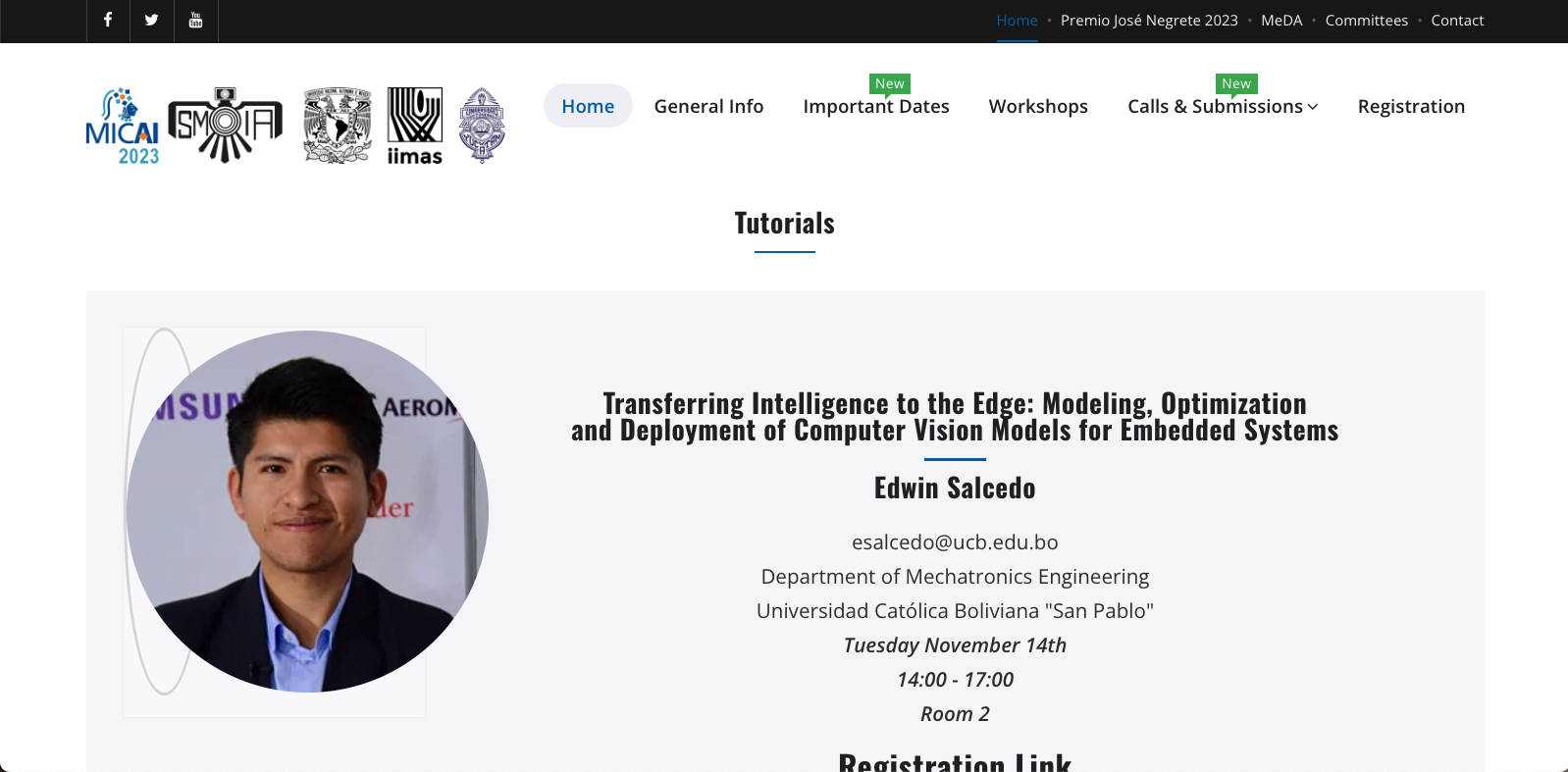
MICAI 2023: Transferring Intelligence to the Edge: Modeling, Optimization, and Deployment of Computer Vision Models for Embedded Systems (Tutorial)

Nov. 14, 2023      Mérida, México